S Hotel J P Nagar Bangalore India review

I stayed at the S Hotel for a week during January 2009. As I was unable to find any reviews, I thought that it might be helpful to post a review of my time there. Not to mention that this is a shameless attempt to get traffic to my blog.

The room was nice, just as it appeared on the web site. It was a little stuffy though, and the fact that there were no non-smoking rooms was unfortunate (the room had the smell of smoke). The only window opened to a ventilation shaft.

The bathroom was also nice, though the biggest problem with the room was that there was no hot water beyond a certain hour. I only found hot water between 19:00 and midnight; there was certainly no hot water in the morning.

The staff were always very friendly, if not always too capable. One receptionist never seemed to understand anything I wanted, with the other on shift always coming over eventually to help. I asked for a wakeup call every morning. The first morning it was 20 minutes early, a couple of times it never came at all. I think it was on time twice.

The breakfast was not bad, though it got a little monotonous. At least my situation was better because I ate the Indian food. It seemed that there was even less of a selection of Western food.

The location of the hotel was reasonable for me, though only because it was close to my work. It was quite a long drive from the center of town to the hotel in the evening; site seeing wouldn't be easy from the hotel.

Driving in Bangalore

IMG_3274
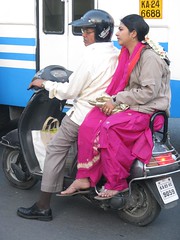
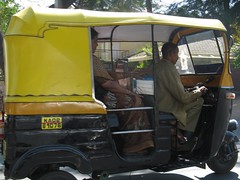
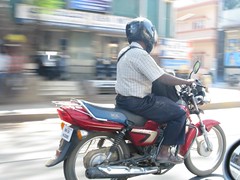
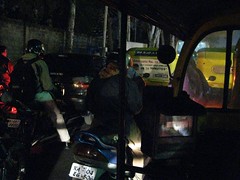
The full chaos of driving in Bangalore has to be experienced to be believed.

First of all, there's the use of the horn. I arrived at 2 in the morning. The streets we drove along to the hotel were quite empty. But my driver still constantly honked his horn. They do it as they approach intersections, where ever pedestrians may be considering crossing or other cars might want to merge. Or even for no discernible reason. There is constant honking.

Next, is keeping high beams on most of the time. This is for lit city streets when there is oncoming traffic!

IMG_3267

Another thing is the use of speed bumps. They seem to be everywhere; small streets or major roads, you never know when you might encounter a speed bump (though they are evidently marked well because my drivers always managed to slow down before reaching them).

IMG_3263

But the main thing is the matter of right of way; the concept doesn't seem to exist. Drivers are not so much aggressive as simply unwilling to give the right of way unless they are forced to.

IMG_3243

At first glance, it would seem that this is similar to how driving is done in Israel. I think that one of the main differences is that Indian drivers cut it a lot closer than Israeli ones. So in India stopped cars will merge into flowing traffic in cases where in Israel it would cause other drivers to panic and slow down or stop. Fortunately, speeds are bit slower than in Israel, so it is easier to avert accidents.

IMG_3262

Not giving right of way is also very much felt when stopped in bumper-to-bumper traffic. Each car, auto-rickshaw and motorcycle driver feels that he must go forward as far as possible. Even if this means blocking cross streets while the way forward is completely blocked with no progress in sight.

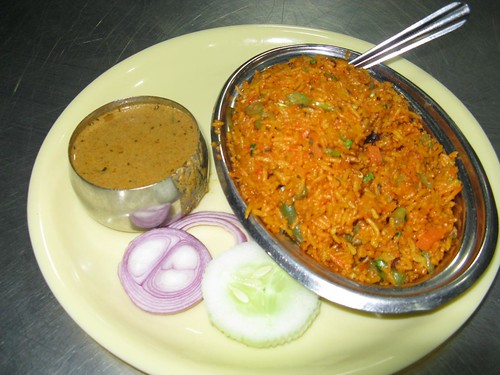
Dinner, Day 6

Vegetarian Biryani (if I'm not mistaken)

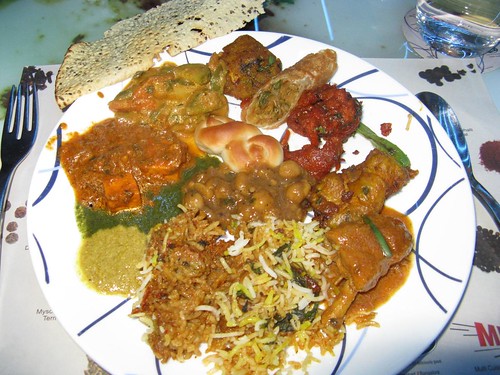
Lunch, Day 5

The guys I was trained in Bangalore took me out for lunch. We went to a restaurant in a mall.

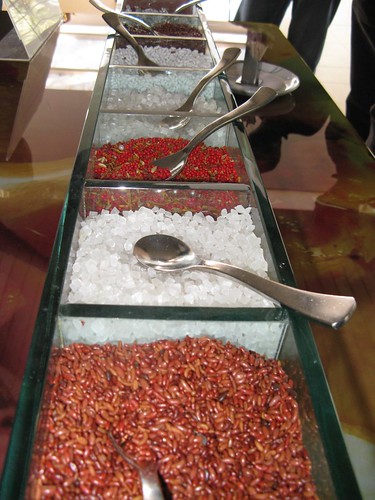
Buffet lunch
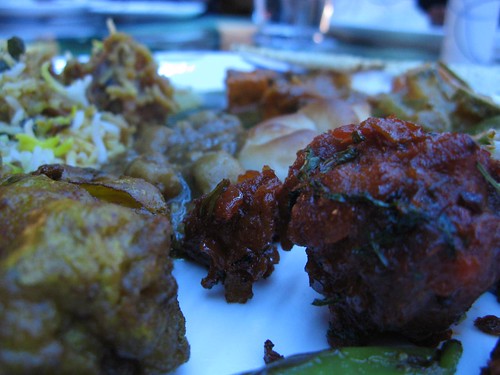
Buffet lunch
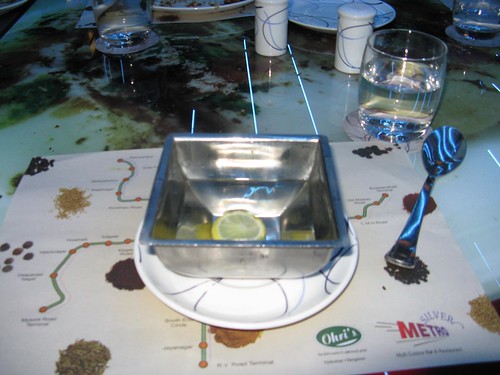
Washing bowl
After meal snack

Quiet night street


Quiet night street
Originally uploaded by daver667
I took this on the street my hotel was on.

Dinner, day 4

Another tali for dinner tonight. Eaten in the food court at the Forum mall.

Something strange I've noticed


There are lots of stray dogs on the street. NO stray cats that I've seen. The opposite of what you see in Israel. I wonder why?

Dinner, day 3


Last night I took a picture of the menu at the local restaurant I've been having dinner at (Chaithanya Cafe). This came in very handy; instead of being reduced to pointing at someones plate (as I did yesterday), with the help of google I was able to choose something that appealed to me. And after getting a little bored with the Indian food I've been having, tonight I picked a winner: malai kofta. Delicious!


For desert, I went to a sweets shop and got 3 different kinds (again, complete with edible tin foil). Being steeped in syrup, they reminded me of baklava. It was quite good; the long brick was the best.

Security in Bangalore


I thought security was tight in Israel. Here in Bangalore, I've seen a few of these (at my hotel and at the EMC campus): mirrors to see that there are no bombs planted on the bottom of a car. I was told that these are new, only appearing since the terrorist attack last month in Mumbai.

Dinner, Day 2


More southern Indian food. Paper masala dosa. Inside is a kind of vegetable stew (very thick).

Insistent room attendant


At around 19:00 an attendant comes to the room to make the room ready for the night. The first night I guess I was more firm in telling him that I didn't need anything -- he didn't come in the room.

Yesterday he kept gesturing to different things he wanted to attend to and I let him in the room. I kept on telling him that he didn't need to do any of his tasks: replacing any used towels (though there were unused spares), laying out the slippers, rearranging and fluffing up the pillows. After a while, I figured that at least I could get some pictures.

Dinner, day 1

Good news: there is hot water! This hotel is improving.

I just returned from dinner. I asked the reception if they knew any Indian restaurants in the area I could try. They directed me to a "international cuisine" restaurant and said that there were no Indian restaurants in the area for me. Luckily, I was able to find a nice one quite near the place they directed me to. I'll have to wait until tomorrow to see if they were right that there was no Indian place nearby for me :-)


The place was full of locals eating all kinds of dinners. Fortunately, there was a menu in English. Of course it would have been more helpful if the menu had pictures as I'm not exactly familiar with Indian food options. But I could choose the Northern Indian food, and after someone helpfully explained that the cashier asked if I wanted to have a dali(?) (i.e. bread and bowls of curries) I got this:


The food was good. The only problem was eating it solely with my right hand (because I understand that it is rude to eat with your left one). I ended up eating both rotis, but leaving a lot of the curries because I wasn't able to mop them up. It is especially hard to tear off a piece of roti using only one hand, though I saw people there doing it very nicely. Eating the rice with my hand was definitely interesting. I was sure messy though! Lots of good food was wasted :-).

Sightseeing in Bangalore

I spent my one day off around in Bangalore with an Indian friend of mine named Vikram.

He took me to the main shopping and eating areas of Bangalore. We then joined up with a friend of his who took us to the main architectural sites of the city.

Pictures here.

Breakfast, day 1

I just had the "south Indian" breakfast. The service was "full service", not buffet. After I got to the table I took my plate and wandered a little, looking for the food. They told me they'd bring it to me.

One funny thing that happened during the meal was that a waiter stood a meter from me, facing me. Attending to me I guess. I managed to ignore him and eat my meal.

* Spiced buttermilk (which had seeds, green chili pepper slices and curry leaves)
* Idly
* Vada
* Sambar and Chutney (the chutney was a coconut chutney; very spicy and delicious!)

These are all shown in the picture here (from Wikipedia -- tomorrow I'll be bringing my camera to breakfast)


Actually, the menu says that there is a choice of either idly or dosa. So I lucked out when the waiter asked me if I wanted dosa and brought it when I said yes.


And this is what was inside the dosa.


The coffee was with tons of milk.

Arrival in Bangalore India


After flying all the way to Frankfurt for a connecting flight (multiplying my travel time by roughly 3), I arrived in Bangalore at 1:30 (AM).

I was told that I would be picked up by a driver from my hotel. At first glance, I wasn't able to find him. But after withdrawing some money from an ATM machine I went and looked for the driver again, and this time I saw the sign for me.

The ride over was pretty uneventful (though it is unsettling to be on the left side of the road, even just as a passenger). The route we took seemed to be going around in circles, but we got here eventually. We managed to pass by some big modern buildings, though on the whole the buildings we passed were low, mean and quite dilapidated. Things built wily nily.


Once at the hotel, I immediately went to take a shower. As you can see from the picture, I won't be soaking too much in the tub :-). Unfortunately, there was no hot water! Oh well. At least it was not freezing cold. And the most important thing at the hotel is working: I have WiFi to connect to the internet. So I'll manage.

That's all for now. I'm going to rest up for my one day of seeing some sights in the city tomorrow.

Funny mixes of English in Hebrew

My Son is 3 years old and is learning English (here in Israel) through my speaking it with him.

He understands English well but speaks it very little. What I have noticed is that he takes English words, translating them literally to Hebrew and uses them in Hebrew sentences.

Here are some examples:

Instead of saying that he has "gas in his tush", he took the English word "gas" (short for gasoline) and translated gasoline to the Hebrew "delek".
End result: he has said "I have gasoline in my tush". יש לי דלק בטוסיק

From the the English phrase "room in my stomach" the word "room" (meaning in this case space) was translated to "cheder" (a room in a house).
End result: "I have a room in my stomach". יש לי חדר בבטן.

The word "falling" from the phrase "falling asleep" was translated literally.
End result: "I think I'll tumble asleep". אני חושב שאני אפול לישון

On being divided culturally

This bit by Herb Keinon in the Jerusalem Post really cracks me up:

It's an odd phenomenon, but Israelis often sound downright European in their tendency to see US culture as shallow and meaningless, and to view the US as incurably naive when it comes to the world. It's an attitude that says we - who live in the tough neighborhood - understand how things work; the Americans are hopelessly unsophisticated.

What you end up with, essentially, is Americans in Israel looking down at Israelis, and Israelis looking down on Americans. And one of the hidden beauties of being an American-Israeli is the ability to look down on both with equal measure. It's a great benefit, actually, and one that should be used by the Nefesh B'Nefesh folks to promote aliya.

"Come home, that way you can condescend not only toward Israelis, which you do in the States, but now toward Americans as well."

So long and thanks for the memories

I've just done something I've been planning for a while, though in the end it wasn't as easy to do as I thought it would be. I donated the first half of my SF book collection to the local library. As soon as I can pack and transport the second half, it too will be given away.

These books were the focus of my life for many of my teenage years (probably too much the focus). Needless to say, I read them all; most of them more than once and many of them numerous times.

The collection stopped being updated by around 1990. It included all of Larry Niven's works up to that point. All of Isaac Asimov's SF books. Many books by Robert A Heinlein. And hundreds of other SF (and a few fantasy) books as well.

I considered trying to sell them, though it seems that the amount of work involved to get a significant sum of money would be too great.

And actually I like the idea of the books being available at the local Modiin public library. I hope that many people find them and enjoy them as I had.


stereotypes

A Frenchman is self-assured because he regards himself personally, both in mind and body, as irresistibly attractive to men and women. An Englishman is self-assured, as being a citizen of the best-organized state in the world, and therefore as an Englishman always knows what he should do and knows that all he does as an Englishman is undoubtedly correct. An Italian is self-assured because he is excitable and easily forgets himself and other people. A Russian is self-assured just because he knows nothing and does not want to know anything, since he does not believe that anything can be known. The German's self-assurance is worst of all, stronger and more repulsive than any other, because he imagines that he knows the truth-- science--which he himself has invented but which is for him the absolute truth.

War and Peace, Book 9, Chapter 10
Leo Tolstoy

Audio books

I've been listening to MP3 audio books during my daily commute to work for quite a few years.

The biggest problem with listening to books is losing your place or getting back to the place you left off after you've taken a break in listening.

During the first year or so, I used a CD MP3 player. Here there was no memory of where I'd left off at all. So the last thing I would do when I was finished listening was to note the track number and minutes/seconds into the track (I used to dial it on my cell phone; a great way to remember a number). When I got back in the car and wanted to resume listening I would have to go back to the correct track, minutes and seconds where I had left off. Very tedious!

After the CD player I had a Pocket PC (I got it from my work -- Destinator Technologies, makers of GPS navigation software). On the Pocket PC I could install a decent MP3 player, one that could help me to keep track of where I was in the book. I used Mirko Schenk's excellent open source MortPlayer. This player even has a special mode to use when playing audio books (which is something I later found out the best MP3 players (like iPod) have to help listen to audio books).

After leaving Destinator and my borrowed PPC behind, I had to find some new way of listening to books during my commute. Going back to the CD player was out of the question because it had a problem with playing tracks in the correct order. This led to life threatening situations where I'd try to find my place in some book while speeding down the highway. Not something I wanted to go back to.

As I also needed to get a cell phone, I thought that I might be able to combine the 2 functions and get a phone with an MP3 player. After much investigation, I got the Motorola MOTORazr V6 MAXX which was supposed to have good MP3 playing capabilities. It turns out that it is a nice phone (my first non-Nokia, and not bad at all) but completely useless for listening to audio books. There is no way to save your place in an MP3, or even in a play list. So each time you want to start a listening session, you would have to laboriously find your place.

So finally I bought a cheap little flash memory based MP3 player from a company called "Bross" (for some every time I turn the device on and I see the word Bross on the screen I always think of someone saying "Hey bro's, how's it goin'?"). Strangely enough, I haven't been able to find any reference to an MP3 player manufactured by Bross anywhere on the internet.

The device has 1GB (which is plenty for audio books), and cost only 140 Israeli Shekels (~$35). It works fine, though with some slightly annoying quirks. One quirk is that sometimes the first first track in a folder will be some file in the middle of the list of files (track 23 out of 100, for example). The tracks are all named uniformly and have no tag info at all. There is no reason I can see why the first track displayed for the folder would not be track 1... The device has a USB port for managing its memory.

Here's a blurry picture of the player taken with my phone's camera:


The device has the crucial feature required to allow it to be used for listening to audio books: it remembers where it was stopped even after turning it off and changing the batteries. This site has a detailed post about what to look for when buying an MP3 player for listening to audio books.

Unfortunately though, sometimes it does forget the previous location inside an MP3 track, forcing me to search through the track for the point I left off. To make this as painless as possible, I've written a script which ensures that my MP3 files are never longer than 5 minutes long each. The script is written in Python, and uses mpgedit to first make 1 huge MP3 file and mp3splt to split it into smaller files.

The script will accept arguments, but the defaults are such that if you run it in a folder with a bunch of MP3s that are in the correct playing order when sorted by name, you will get good results. Some other processing that might be useful to do to the MP3s is to increase the volume (this is done in the script using mp3gain but currently commented out) or to decrease the sample rate in case you are limited in space and have MP3s with a bit rate of over ~44kbps (not needed for speech recordings) -- easily done using lame.

Here's the script:
import getopt, sys, glob, shutil, os, re
from subprocess import call

def usage():
usage_text="""
usage: ebook-mp3.py [-n ] [-d ] [-p ]
"""
print usage_text

def main():
try:
opts, args = getopt.getopt(sys.argv[1:], "n:d:p:")
except getopt.GetoptError:
# print help information and exit:
usage()
sys.exit(2)
mpgedit = r"D:\Program Files\mpgedit.org\mpgedit\mpgedit_nocurses.exe"
mp3splt = r"D:\etc\mp3splt-2.1\mp3splt.exe"
mp3gain = r"D:\Program Files\MP3Gain\mp3gain.exe"
new_name = None
dest_dir = "."
source_pattern = "*.mp3"
for o, a in opts:
if o in ("-n"):
new_name = a
if o in ("-d"):
dest_dir = a
if o in ("-p"):
source_pattern = a
source_files = glob.glob(source_pattern)
if new_name == None:
new_name = raw_input("Enter base name for split files:")
mpgedit_args = [mpgedit, '-o', new_name, '-e-']
mpgedit_args.extend(source_files)
call(mpgedit_args)
for filename in source_files:
os.remove("%s.idx" % filename[ : -4])
# call([mp3gain, "/r", new_name])
call([mp3splt, "-q", "-n", "-a", "-t", "5.0", "-d", dest_dir, new_name])
os.remove(new_name)
for filename in glob.glob("%s*.mp3" % new_name):
shorter_filename = re.sub(r"%s_(\d{3})\.00_(\d{3})\.00" % new_name,
r"%s_\1_\2" % new_name, filename)
os.rename(filename, shorter_filename)

if __name__ == "__main__":
main()

...and even more personal.

I've changed the title of the blog to being my name. I previously called it Mirrorshades because of a picture of my son wearing my mirrorshade sunglasses (and because I liked the cyberpunk/mirrorshade science fiction books so much in my past) which appeared in the heading of the blog. But I've since removed the picture, so at this point the name just sounds juvenile to me.

Blog updates

I've updated the blog description to something I saw on Mark Pilgrim's blog (dive into mark): useful or personal. Seems like a good intent for my blog content.

In keeping with that I've made the blog a bit more personal by including my full name ;-). Much more personal than it was before.

P2P when your PC is idle

I've noticed that keeping a BitTorrent client running can be a bit of a pain. On the one hand you don't want it on while you are using the computer (so that it doesn't suck your bandwidth), but on the other hand it's easy to forget to turn it back on after you've finished with the computer.

A solution I've found (on Windows) is to schedule the client to run when the PC is idle, also setting it to stop running when not idle.

Create a scheduled task (Start->Control Panel->Scheduled tasks) where the file to run is your P2P client (such as EMule or uTorrent). If you don't know where the file you need to run is you can get the location from the shortcut you normally use to start the client.

See the screenshots for how to configure your new task.


Note the checkbox for "Stop the task if the computer ceases to be idle". I'm not sure how well this works; if it is not set then you will have to close the client when you want to start using the internet.

Handling and Archiving Home Digital Video

I bought a digital video camera over 3 years ago (right after the birth of my first child) but have only now figured out how to best handle the video it produces.

Video is not like still pictures; you can't just print out the stills you like and stick them in an album. Ideally, after you've shot some video footage, you need to become an editor and make an effort to take your best footage to create an enjoyable movie. One of these days I'll get around to doing that...

In the meantime, I wanted to a) be able to see the video I've shot and b) store it for some future time when I might want to create some edited movies.

The procedure:

Step 1


Video capture; Transferring the video from camera to PC.

The important point of the transfer is to not lose data while transferring. In order to do this, store the video on the PC as DV AVI. This means that the stored video is the full original size and completely uncompressed. The downside of capturing the video in this format is that it takes up a lot of space (about 217 megabytes for 1 minute of video). Though with the low prices of hard disks today, this is not a big problem for most people.

I recommend using a simple and lightweight (and free) application for transferring called WinDV, detailed usage help here. WinDV works great (most importantly, it never drops frames). Once small gotcha I've noticed with it though is that the first clip saved has the current date/time, rather than the date/time when the video was recorded. Make sure you rename that clip to the correct time (which WinDV displays correctly on the screen while transferring) to help you to sort out the clips at a later time.

Step 2


Encoding (compressing)

The raw footage captured in step 1 has some problems.
1. It's huge. In its uncompressed form, only about 20 minutes will fit on a DVD.
2. It can't be easily viewed. A DVD with the raw footage can't be put into a DVD player and viewed.
3. It's interlaced. Check out the site 100fps.com for more information about what that means.

To solve these problems, I encoded the footage using the latest DivX codec (version 6.6.1), with the following settings:


Once the video is saved in this format, it is much smaller (about a 1:6 ratio) and playable on a DVD player that reads the DivX format. The quality of the encoded video is also excellent; I don’t see any degradation in quality between it and the raw footage, though there doubtless is some.

In addition to the video compression, I also compressed the audio using LAME MP3 at 128kbps CBR.

The encoding work is done with the free app VirtualDub. I found a short script to remove the tedium of creating the VirtualDub encoding jobs at this site, “Scripted VirtualDub Job Creation”.

This is the contents of the VirtualDub configuration file used to duplicate my settings:
VirtualDub.audio.SetSource(1);
VirtualDub.audio.SetMode(1);
VirtualDub.audio.SetInterleave(1,500,1,0,0);
VirtualDub.audio.SetClipMode(1,1);
VirtualDub.audio.SetConversion(0,0,0,0,0);
VirtualDub.audio.SetVolume();
VirtualDub.audio.SetCompressionWithHint(85,32000,2,0,16000,1,12,"AQAEAAAAQAIBAAAA","LAME MP3");
VirtualDub.audio.EnableFilterGraph(0);
VirtualDub.video.SetInputFormat(0);
VirtualDub.video.SetOutputFormat(7);
VirtualDub.video.SetMode(3);
VirtualDub.video.SetFrameRate(0,1);
VirtualDub.video.SetIVTC(0,0,-1,0);
VirtualDub.video.SetCompression(0x78766964,0,10000,0);
VirtualDub.video.SetCompData(145,"LWJ2MXEgMSAtdmJ2IDQ4NTQwMDAsMzE0NTcyOCwzMTQ1NzI4IC1kaXIgIkM6XERvY3VtZW50cyBhbmQgU2V0dGluZ3NcRE1SXEFwcGxpY2F0aW9uIERhdGFcRGl2WFxEaXZYIENvZGVjIiAtYiAxIC1wIC1uZiAtcHJvZmlsZT0zIC1kZWludGVybGFjZT0xAA==");
VirtualDub.video.filters.Clear();
VirtualDub.audio.filters.Clear();

Step 3


Burning onto DVD

I burned the encoded DivX AVI files onto DVDs using the omnipresent Nero.

The final DVDs are ready for viewing in modern DVD players which support DivX playback.